

The Hidden Aging Risks of a Florida Winter
Florida’s mild December temperatures create a false sense of security — and that complacency quietly accelerates skin aging in ways most residents never connect to the season.
The dehydration trap is real, even in Florida. When indoor heating systems run alongside lower outdoor humidity, the water content in the epidermis can drop below 10%, according to the American Academy of Dermatology. At that threshold, the skin barrier develops micro-cracks — tiny fissures invisible to the naked eye that allow moisture to escape and environmental irritants to enter. The result is not just dryness; it is a structurally compromised barrier that ages faster and recovers more slowly from everyday stressors.
The seasonal shift also demands a complete rethink of your product strategy. As the International Dermal Institute notes, “winter skin requires a shift from oil-control to lipid-replacement, as cold air and indoor heating strip the skin of essential fatty acids.” The light gel moisturizer that performed well through a humid Central Florida summer is no longer adequate. Your skin is now losing lipids it cannot replace on its own, and the gap between what it needs and what your current routine provides widens every week.
This is precisely why a seasonal anti-aging facial in Winter Garden is worth considering as a clinical intervention rather than an optional indulgence. Treatments like targeted light-based skin therapy can support barrier repair from within — but even those work best on skin that has been properly prepared. And that preparation is where professional care becomes essential, as the following section explores.
Why Professional Intervention Beats At-Home Care
Professional-grade treatments address what drugstore products simply cannot — the biological slowdown of skin cell renewal that occurs with age.
At-home moisturizers maintain the surface; they do not rebuild what aging has already compromised. According to the Dermatologic Clinics Journal, skin cell turnover slows by approximately 30–50% between the ages of 20 and 80. That means dead, dull cells linger longer on the surface, creating a thickened barrier that blocks even high-quality serums from reaching the deeper layers where they do meaningful work.
Exfoliation is where professional treatment earns its advantage. A licensed esthetician can deploy clinical-strength acids, enzymes, or mechanical methods calibrated to your exact skin condition — something a store-bought scrub cannot replicate. Once that surface congestion is cleared, the anti-aging actives in your treatment serums penetrate far more effectively, reaching the dermal layers where collagen production actually occurs.
Consistency matters just as much as the treatment itself. A winter facial for dry skin is not a one-time indulgence; it is a maintenance strategy that keeps cell renewal moving at a pace your biology no longer sustains on its own. In practice, clients who schedule monthly appointments tend to see compounding results — each session building on the last rather than starting from scratch.
And once that cellular foundation is reset, the next logical step is giving your skin the energy it needs to rebuild from within — which is exactly where light-based therapies enter the picture.
Collagen Boosting: The Role of Red Light Therapy
Collagen boosting facial treatments represent one of the most significant advances in non-invasive anti-aging — and the science behind them is more precise than most people realize.
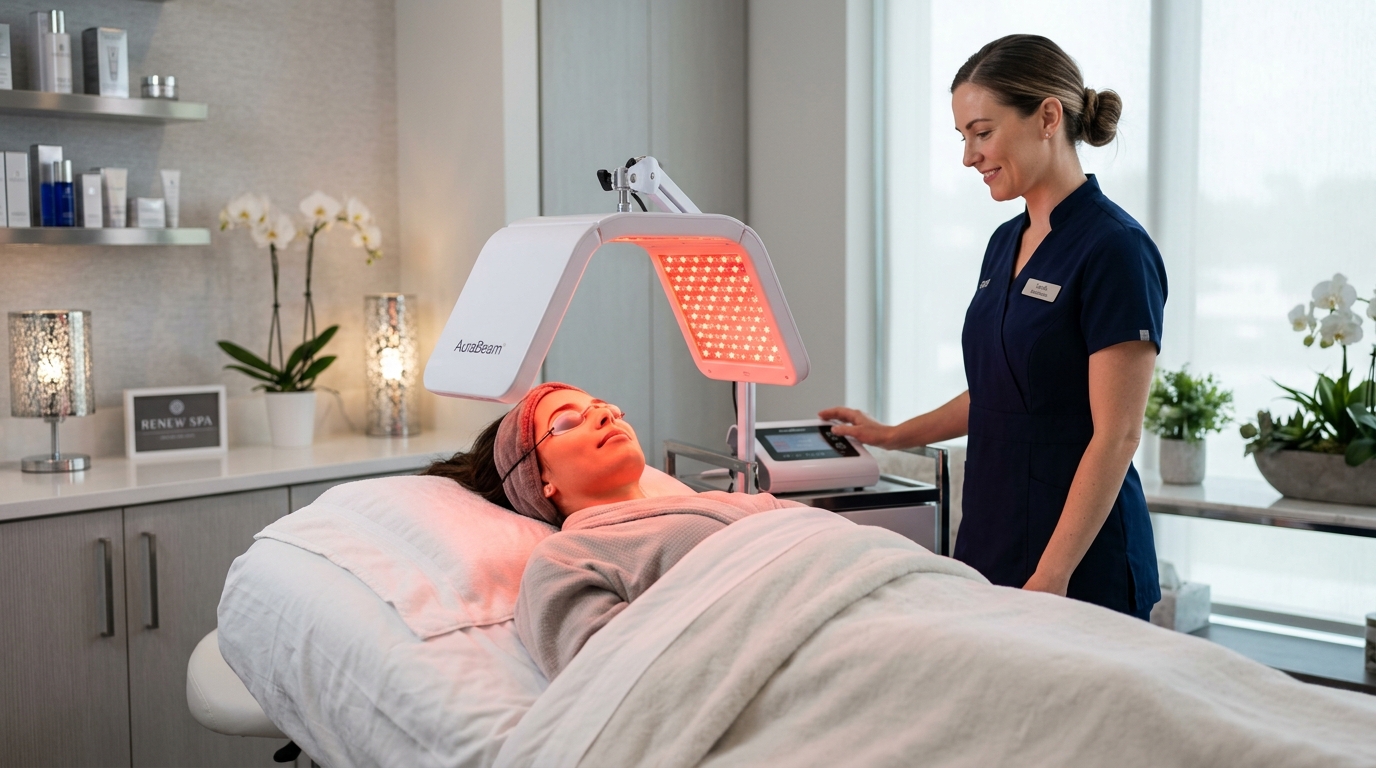
Photobiomodulation (PBM) is the clinical term for using specific wavelengths of light to trigger biological responses inside the skin. Rather than relying on topical products to nudge the surface, this technology works at a cellular level. According to the Journal of Clinical and Aesthetic Dermatology, red light delivered at 633nm and 830nm wavelengths directly stimulates fibroblast activity — the cells responsible for producing collagen — while measurably reducing the depth of fine lines over repeated sessions.
What makes those specific wavelengths matter is penetration depth. The 633nm wavelength targets surface-level skin renewal, while 830nm reaches deeper dermal tissue where structural collagen lives. And because no heat, needles, or downtime are involved, this approach tends to work particularly well for Winter Garden residents who want consistent results without disrupting their routines. You can explore what a dedicated light therapy session looks like in practice before committing to a full protocol.
In practice, red light therapy integrates naturally into premium facial experiences — including the kind of luminosity and firmness associated with the Platinum Ice & Glow results that locals actively seek. The combination of targeted wavelength therapy with complementary treatments creates cumulative collagen support that at-home devices simply cannot replicate. However, results do require consistency — occasional sessions produce limited change, while a structured series delivers the compounding benefit the science supports.
One important caveat to keep in mind: even as red light therapy works beneath the surface to rebuild collagen, external stressors continue working against it. That is a dynamic worth understanding before the following section.
The UV Myth: Why Winter Protection Still Matters
Skipping sun protection in cooler months is one of the most damaging mistakes you can make for your skin’s long-term health — and in Central Florida, the stakes are even higher.
UV rays do not take a winter break. According to the Skin Cancer Foundation, UV radiation remains a primary driver of extrinsic aging year-round, regardless of ambient temperature. Florida’s lower sun angle in winter does little to reduce UVA exposure — the wavelength most directly linked to collagen breakdown, hyperpigmentation, and accelerated skin aging. You may feel cooler outside, but your skin is absorbing the same photoaging stress it would in July.
Winter dryness compounds the problem. When skin loses moisture — through cooler air, indoor heating, and reduced humidity — its barrier function weakens. A compromised barrier is less capable of deflecting environmental aggressors, which means UV damage penetrates more efficiently. This is especially relevant if you have recently invested in a winter skin care facial or a professional treatment like red light therapy; unprotected sun exposure can actively reverse those gains within days.
Choosing the right SPF matters as much as wearing it. A broad-spectrum SPF 30 or higher formulated with hydrating ingredients — think hyaluronic acid or ceramides — addresses both risks simultaneously. Protecting your skin from UV damage is not just a warm-weather habit; it is the foundation that keeps every professional treatment working longer, which is exactly the kind of consistent, layered approach that local providers in the Winter Garden and Horizons West area area are built to support.
Finding the Best Facials Near Horizons West area and Orlando
Residents of Horizons West area no longer need to drive into downtown Orlando to access high-caliber, results-driven skincare — and that shift is changing how locals approach their anti-aging routines.
The West Orlando corridor has seen a meaningful expansion of advanced aesthetic providers, making treatments like a facial for fine lines and wrinkles genuinely accessible without sacrificing clinical quality. But accessibility alone does not guarantee results. What separates an effective provider from a generic spa experience comes down to a few non-negotiable factors.
The right credentials matter more than the ambiance. When evaluating a local provider, prioritize FDA-certified equipment, licensed estheticians with documented advanced training, and a menu that reflects current evidence-based protocols — not just trending treatments. Yelp’s local search data for Horizons West area shows a growing concentration of medically adjacent spas in the 34787 zip code, reflecting exactly this demand shift. J Sterling’s Winter Garden location reinforces that standard with FDA Class II certified Red Light Therapy as part of their core aesthetic offerings.
Membership models tend to work better for anti-aging goals than single-visit bookings. Consistent monthly treatments — rather than occasional appointments — are what drive measurable improvements in skin texture, tone, and firmness over time. Many providers in the area now offer tiered membership structures that make this regularity affordable.
This is the “accessible luxury” trend reshaping local skincare: premium clinical results at a price point that fits a realistic monthly budget. Knowing what to look for, and where to find it, is half the work — and the other half is building a routine that sticks.
The Bottom Line: Your Winter Skincare Checklist
Consistent, season-aware skincare is the single most effective strategy for slowing visible aging — and Florida winters give you a genuine window to act.
Here is what that action looks like in practice:
- Switch to lipid-rich professional products. Cooler temperatures and lower humidity pull moisture from the skin barrier. Replacing lightweight summer formulas with ceramide- and fatty acid-based treatments prevents the micro-damage that accelerates fine lines.
- Schedule monthly facials to maintain cell turnover. Regular professional exfoliation keeps dead cell buildup from dulling your complexion and allows active ingredients to penetrate effectively. If you are already exploring the best facials near Horizons West area, consistency matters as much as the treatment itself.
- Incorporate Red Light Therapy for collagen health. As covered earlier, this modality stimulates fibroblast activity at a cellular level — making winter the ideal time to build collagen reserves before summer UV exposure resumes.
- Never skip SPF, even on cool Florida days. UVA radiation does not drop with the temperature. Daily broad-spectrum SPF 30 or higher remains non-negotiable, regardless of cloud cover or season.
- Visit a specialist for a customized skin analysis. Generic routines produce generic results. A trained aesthetician or medical provider in Winter Garden can assess your barrier function, pigmentation concerns, and collagen loss to build a protocol that actually fits your skin.
The most effective anti-aging strategy is not a single product — it is a coordinated plan built around your skin’s real needs. Each of these steps reinforces the others, and the cumulative effect over a single winter season can be significant. The next question is where to start that plan locally.
Start Your Wellness Journey in Winter Garden
Winter Garden residents now have a genuinely accessible path to consistent, medical-grade anti-aging care — and the barrier to entry is lower than most people expect. Affordable, results-driven skincare does not require choosing between quality and budget. The Sterling Wellness Circle membership offers access to customized facials starting at $79, making it realistic to stay on a regular treatment schedule rather than booking a single session and hoping for the best.
What sets this approach apart is the combination of deep relaxation and clinical-grade technology working together. In practice, a well-designed facial treatment does more than address surface concerns — it supports the skin’s natural repair processes, addresses seasonal stressors like the dry air and UV exposure typical of Florida winters, and delivers the kind of cumulative improvement that a single at-home routine simply cannot replicate.
And the timing genuinely matters. Winter is the ideal reset window: cooler temperatures, reduced sun intensity, and skin that is primed to absorb active ingredients more effectively. Starting your seasonal skincare reset now means entering spring with a measurable head start on collagen support, hydration, and tone correction.
“Your wellness journey is not a single appointment — it is a rhythm of care that compounds over time, season after season.”
Book your consultation today and take the first step toward skin that reflects how well you care for it.