

Top Massage Head Types for Neck Tension Relief
Neck tension is one of the most common complaints heard by physical therapists and wellness professionals among people with different lifestyles, work routines, and activity levels. Percussion massage guns have become a popular at-home option for managing muscle discomfort, and the reason is easy to understand: they are convenient, accessible, and simple to operate.
The challenge is not the device itself. The neck is one of the most anatomically complex and sensitive areas of the body, and using the wrong attachment — or applying the correct attachment incorrectly — can create unnecessary risk. If you are wondering which massage head for neck relief is actually appropriate for home use, understanding the differences between each attachment is essential. For hands-on care, explore our massage experiences.
This guide explains which massage gun heads are better suited for neck tension, which muscles they are designed to target, how to use them safely, and when a handheld device may not be enough. Many people try different tools hoping to solve recurring tension, only to discover that the issue keeps returning. At J Sterling’s in Winter Garden, therapists frequently work with clients who have experimented with home devices but still need a more personalized approach to address the underlying cause of their discomfort.
Why the neck isn’t like your shoulders or back
Some people approach the neck as if it is simply a smaller version of the upper back — tighter muscles requiring the same type of pressure. That assumption can create problems. The neck contains important blood vessels, including the carotid arteries and jugular veins, the cervical spine, and a complex network of nerves that connect the brain with the rest of the body.
Unlike larger muscle groups such as the glutes or thighs, many areas around the neck have less protective tissue between the skin and these sensitive structures. This means that a percussion device used in the wrong location does not simply become ineffective — it can potentially irritate nerves, create excessive pressure, or aggravate sensitive areas.
Professionals often consider the neck one of the highest-risk regions for massage gun use, not because percussion therapy has no benefits, but because precision matters much more in this area.
Before using any attachment near your neck, remember:
- Thin muscle tissue in several neck regions provides limited cushioning against strong percussive force
- The carotid arteries and jugular veins are located close to the surface on the sides of the neck
- Cervical vertebrae are smaller structures that require more caution than larger areas of the spine
- Incorrect use of percussion devices in sensitive areas has been associated with rare but serious complications, which is why proper technique matters
These considerations do not mean you must avoid percussion therapy completely. They mean that knowing where to apply it, which attachment to choose, and how much intensity to use makes the difference between supportive use and unnecessary risk.
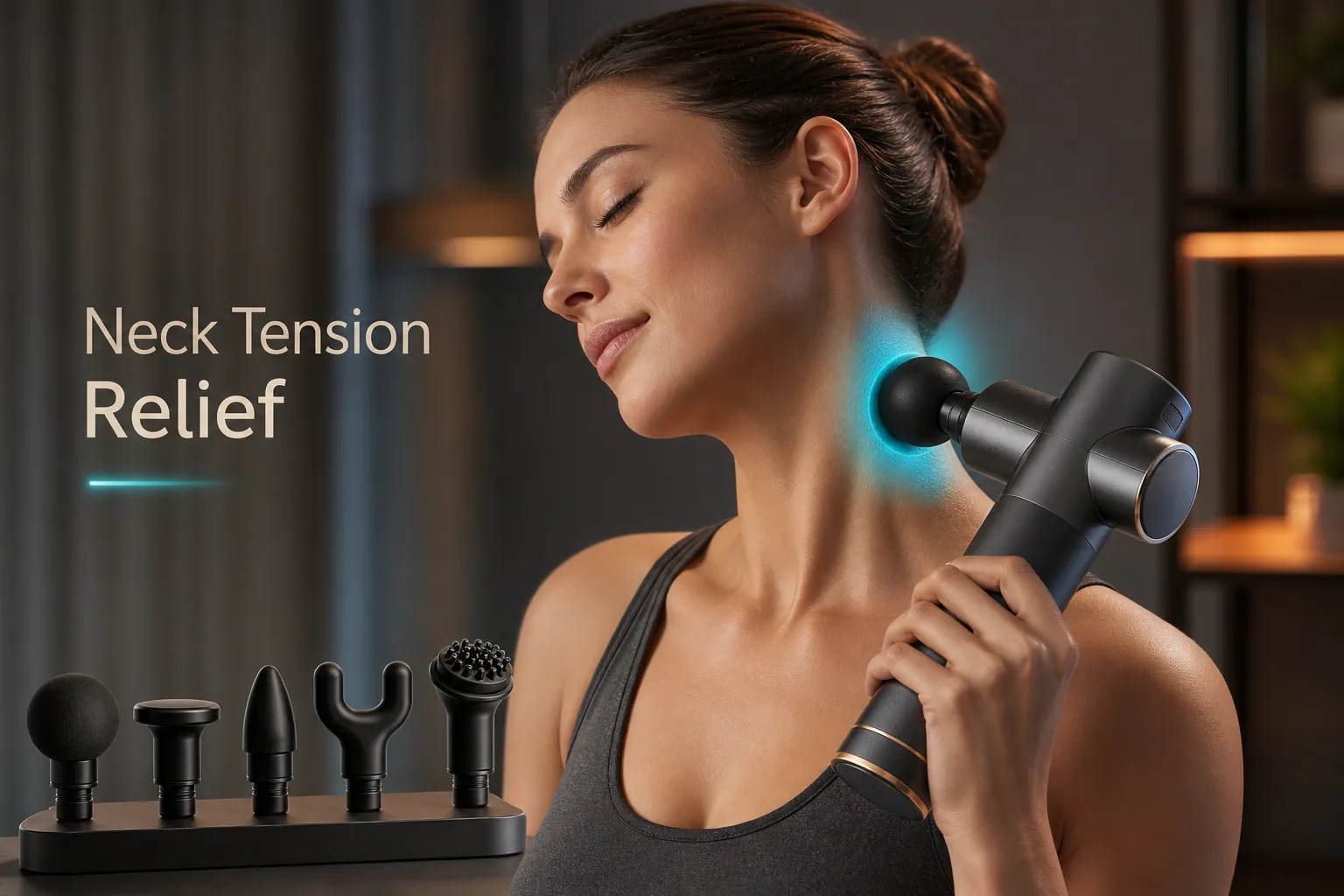
Massage gun heads for the neck: the four main attachment types
Many guides simplify the answer by saying “use a softer attachment.” While that advice is a good starting point, each massage gun head has a different purpose. Understanding how each one distributes force helps you choose the option that best matches your needs.
Which massage head for neck is safest: the soft ball head
The padded round ball head is generally considered the most forgiving option for neck-related tension because it spreads impact across a wider surface area instead of concentrating pressure into one small point.
This design makes it better suited for broader areas such as the upper trapezius and the muscles along the back and sides of the neck. The softer material absorbs some of the vibration and allows more controlled stimulation, which is especially helpful for people who are new to percussion devices.
If you are choosing one attachment for occasional neck tension, the soft ball head is usually the safest starting point. This type of massage gun attachment for neck use provides a better balance between comfort and effectiveness compared with harder, more concentrated heads.
The main advantage is not that it creates the strongest sensation. The advantage is that it allows you to work the surrounding muscles without unnecessarily increasing pressure on sensitive structures.
Fork (straddle) head: designed for muscles alongside the spine
The fork attachment is designed with two contact points that sit on either side of a muscle area rather than directly on a central structure. When used correctly, it can target muscles that run parallel to the cervical spine, such as parts of the paraspinal muscles.
However, this attachment requires more awareness and control than a soft ball head. It should always be used at a low intensity, avoiding direct contact with the vertebrae themselves.
For experienced users who understand positioning, the fork attachment can provide focused stimulation to specific muscular areas. For beginners, the wider and softer contact of the ball head is often easier to control.
Flat head: useful for the upper traps, not the neck itself
The flat head is better suited for larger muscle areas, especially the upper trapezius — the thick band of muscle between the base of the neck and the shoulder.
This attachment distributes pressure more evenly than a pointed head, making it useful for areas where there is more muscle tissue available. However, it should not travel upward into thinner areas of the neck where there is less protective tissue.
The upper traps can tolerate more pressure than the cervical region, which is why the same attachment that feels comfortable on the shoulders may not be appropriate higher on the neck.
Bullet head: keep it away from the neck entirely
The bullet attachment concentrates force into a very small contact point. That design can be useful for dense muscle groups where targeted pressure is appropriate, such as certain areas of the legs or glutes.
The neck is different.
Using a bullet head near the cervical region creates unnecessary risk because the concentrated force is being delivered into an area with smaller muscles and more sensitive structures. Most professionals recommend avoiding the bullet attachment on the neck completely.
More intensity does not automatically mean better results. For neck tension, controlled stimulation and correct positioning are more important than aggressive pressure.
Which muscles are actually safe to target (and where to never go)
Choosing the correct attachment is only one part of using a massage gun safely. The second — and equally important — part is knowing exactly where that attachment should be applied.
The neck contains areas where percussion may support muscle relaxation, but it also contains regions where direct pressure should always be avoided. Understanding this difference prevents one of the most common mistakes people make: assuming that because a massage gun feels comfortable in one area, it is automatically safe everywhere.
The four muscles worth targeting
Percussive therapy is generally better suited for muscular areas with enough soft tissue coverage and clear separation from vulnerable structures. The following areas are commonly associated with neck and upper-body tension:
- Upper trapezius: the broad muscle extending from the base of the neck toward the shoulders. This is one of the most common areas where people hold stress, especially from prolonged sitting, computer work, or posture-related tension.
- Levator scapulae: a muscle connecting the upper cervical region to the shoulder blade that often becomes tight during repetitive movements and poor posture patterns.
- Cervical paraspinals: the muscles running alongside the back of the cervical spine that help support posture and head movement. These should always be approached carefully and never with aggressive pressure.
- Suboccipitals: small muscles located beneath the base of the skull that may contribute to tension headaches. If addressed, they require gentle technique and should not be treated with heavy percussion directly against the skull.
The goal is always to stimulate muscle tissue, not to force pressure into areas where bones, nerves, or blood vessels are close to the surface.
Where you should never put a massage gun
Certain areas of the neck should be considered completely off-limits for percussion devices.
The front of the neck, including the throat area, should never be treated with a massage gun. The sides of the neck where you can feel a pulse should also be avoided because important blood vessels and nerves are located close to the surface.
Directly over the cervical vertebrae is another area where percussion should not be applied. A simple rule is useful: if you can clearly feel your pulse in the area where you plan to use the device, do not place the massage gun there.
The safest approach is to remain on larger muscle areas and avoid chasing intensity in anatomically sensitive zones.
Speed, pressure, and technique for safe at-home use
Having the right attachment does not automatically make a massage gun safe. The way you apply it determines whether the session supports muscle relaxation or creates additional irritation.
A common mistake is assuming that stronger vibration and more pressure will produce better results. With the neck, the opposite is usually true. The goal is controlled stimulation, not aggressive force.
Start lower than you think you need to
For neck-related tension, begin with the lowest available speed setting on your device. Most people do not need high intensity because the muscles in this region are smaller and more sensitive than larger muscle groups.
Physical therapy professionals commonly recommend starting at the gentlest level and increasing only if the tissue responds comfortably. The sensation should feel like mild stimulation, not deep pounding.
If you find yourself pressing harder because you are not feeling enough intensity, that is usually a sign to reassess your technique rather than increase the force.
For additional guidance about safe percussion use, understanding how massage gun attachments work can help you choose the correct approach for different areas of the body.
Timing: short passes, not sustained pressure
Massage guns are designed for movement, not prolonged pressure in one location.
Avoid holding the device in one spot for extended periods. Instead, use slow movements along the muscle fibers and allow the attachment to glide across the targeted area.
A short session is usually enough. Spending several minutes repeatedly working the same sensitive area does not necessarily create better results and may increase irritation.
Give your tissue time to recover
More frequent use does not always mean faster relief.
The muscles and connective tissues around the neck need time to respond between sessions. Using percussion repeatedly throughout the day can create additional sensitivity, especially if the original tension is related to posture, stress, or repetitive strain.
If you constantly find yourself reaching for the device every few hours because the tension keeps returning, that may indicate that the underlying cause requires a more complete approach.

Contraindications: when to skip the device entirely
Some situations require avoiding percussion therapy near the neck completely. In these cases, using a massage gun is not simply ineffective — it may increase risk.
Anyone with a history of blood clotting disorders, vascular conditions, recent stroke, or certain neurological concerns should speak with a healthcare professional before using percussion devices in sensitive areas.
People with cervical disc issues, recent neck injuries, whiplash, or unexplained neck symptoms should also avoid self-treating with high-intensity tools until the cause of the discomfort is better understood.
Acute injuries require additional caution. If neck pain developed after an accident, sudden movement, or trauma, percussion therapy should not be the first step. The tissue needs proper assessment before applying mechanical stimulation.
Warning signs that mean you should stop using the device include:
- Numbness or tingling traveling into the arm or hand
- Sudden headaches during or after use
- Dizziness or changes in balance
- Increased pain instead of relief
- Weakness or unusual sensations
These symptoms indicate that continuing at-home percussion may not be the right approach.
What no attachment can replace: the case for professional therapeutic care
At-home percussion tools can be useful for occasional muscle tension when they are used correctly, with the appropriate attachment and within safe areas of the body. They provide convenience and can become part of a broader wellness routine.
However, every device has limitations.
A massage gun operates with preset speeds, fixed attachments, and a standardized movement pattern. It cannot evaluate your posture, identify compensation patterns, recognize when one muscle is working harder because another area is restricted, or adjust pressure based on how your tissue responds during the session.
That is where professional therapeutic massage creates a different experience.
A trained therapist does more than apply pressure. They assess where tension is actually coming from, identify patterns contributing to discomfort, and adapt techniques throughout the session. Neck tension is often connected to more than one factor — prolonged sitting, repetitive movements, stress, shoulder positioning, previous injuries, and muscle imbalances can all contribute.
At J Sterling’s in Winter Garden, therapeutic massage sessions are designed around the individual rather than a preset routine. Instead of simply treating the location where discomfort is felt, therapists consider the surrounding muscles and movement patterns that may be contributing to the problem.
For clients dealing with recurring neck tension, a professional approach can address areas that a handheld device cannot reliably reach. Techniques such as targeted soft tissue work, focused pressure, and customized massage strategies allow treatment to adjust based on your body’s response in real time.
If you have been consistently using a massage gun and still wake up with the same neck stiffness, that may be a sign that the issue requires more than another attachment or a stronger setting.
A personalized therapeutic massage session at J Sterling’s is designed around your needs, and clients who choose the Sterling Wellness Circle membership can build consistent wellness care into their routine rather than relying only on occasional relief.
At J Sterling’s, you’ll find content about spas, massages, and much more to help you stay healthy. Read more about “how to massage spa“
Which massage head for neck tension: the bottom line
When deciding which massage head for neck use, the answer comes down to three factors: anatomy, attachment design, and proper technique.
The soft ball head remains the safest general option for the posterior neck and upper trapezius because it distributes force across a wider surface area. The fork head can be useful for certain muscles alongside the cervical spine when used carefully and at low intensity. The flat head is better reserved for larger muscle areas such as the upper trapezius. The bullet head should remain away from the neck because its concentrated pressure creates unnecessary risk in a sensitive region.
The most important rule is that more intensity does not automatically create better results. Neck tension responds better to controlled stimulation, correct positioning, and consistency than aggressive pressure.
Whatever attachment you choose, use low speed, light contact, and short sessions. Avoid the front and sides of the neck, stay away from the cervical vertebrae, and pay attention to how your body responds.
A massage gun can be a useful tool for temporary muscle tension, but it cannot replace the assessment and adaptability of trained hands. If your neck tension continues returning despite proper home care, your body may be signaling that the underlying cause needs a more personalized approach.
The team at J Sterling’s in Winter Garden works with clients who have tried different at-home solutions and are looking for longer-lasting support. A professional session can help identify what your body actually needs instead of simply increasing intensity on a device.
Book a session, discuss where your tension is located, and allow a professional to create an approach based on your individual goals.